
Saastamoinen Foundation has consistently promoted the development of forest bioeconomy research and education over the long term. The Foundation supports the University of Eastern Finland’s forest bioeconomy research, education, and the internationalisation of societal interaction with EUR 757,000 for the years 2022–2026. Promoting the forest bioeconomy is key to the sustainable utilisation of forest resources in Finland and internationally.
The University of Eastern Finland conducts innovative and scientifically high-quality research in the field of forest information technologies. A good example of this is the development of remote sensing technologies, which enable more accurate tree measurements, thereby ensuring the sustainable utilisation of wood resources.
A deeper understanding of wood and forest ecosystems
Assistant Professor Tuomas Yrttimaa investigates the use of laser scanning for monitoring tree growth and predicting wood quality to determine its potential uses. The functioning of forest ecosystems and the services they provide ultimately stem from individual trees.
“Forest ecosystems are complex entities. Although forest research has been conducted for a long time, we still have knowledge gaps regarding how individual trees grow and what kind of wood material they produce,” Yrttimaa explains.
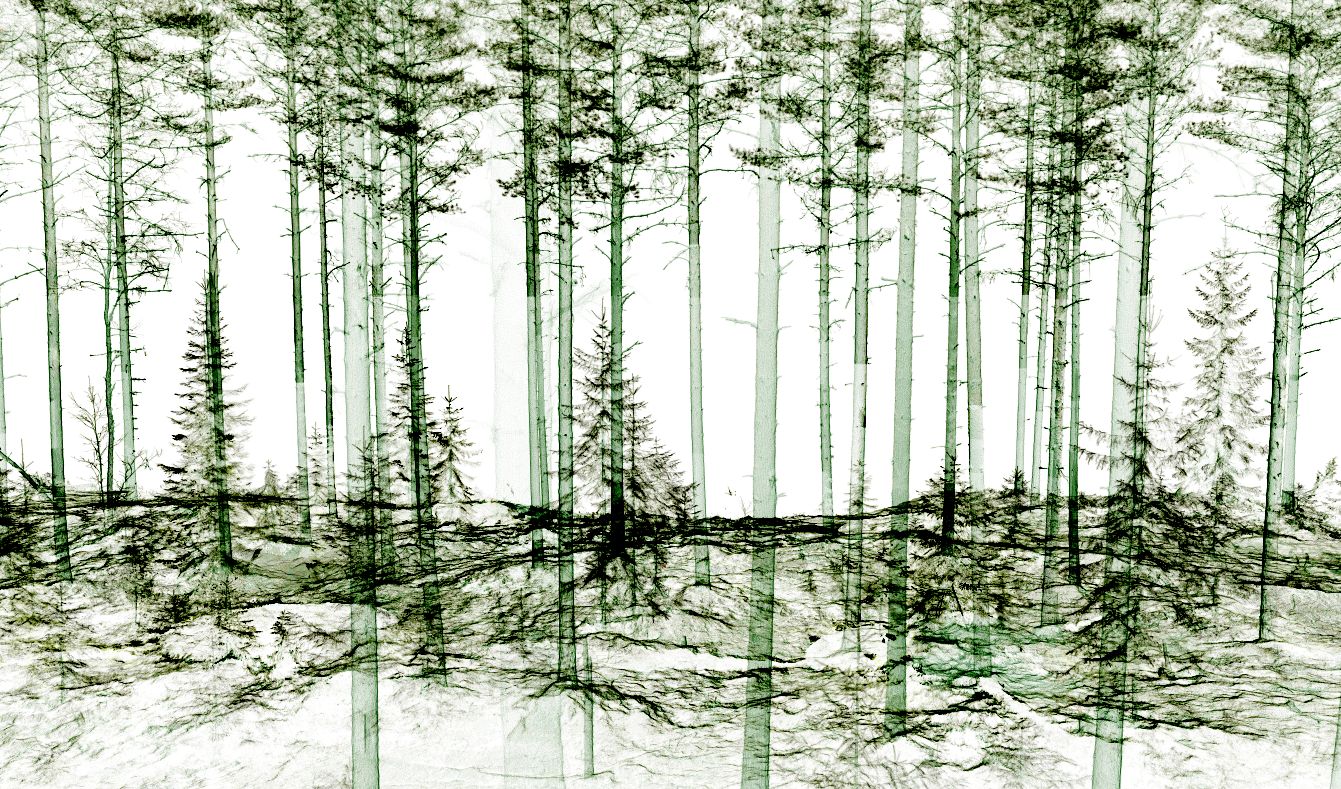
With traditional measurement techniques, wood quality can often only be assessed after the tree has been felled. With new technology, the tree’s three-dimensional structure can be modelled using laser scanning, allowing for more precise measurements of trees in forest sample plots even before felling. Although laser scanning has been used for a couple of decades, for example, in reconstructing built environment, the complexity of the forest environment, with its branches, undergrowth, and foliage, poses its own challenges.
The University of Eastern Finland is also developing the processing and automation of 3D modelling of forest stands, including algorithms that produce detailed information about the trees in sample plots from point cloud data collected by laser scanning. Without accurate measurements, it is difficult to assess how the forest bioeconomy can be practised or developed.
Forest resource measurement enters a new era
One of Yrttimaa’s concrete future goals for his research is the reform of sample plot measurements. In collaboration with parties such as the Finnish Forest Centre, mobile methods are being developed that could revolutionise the collection of forest resource data. Currently, sample plot measurement requires two people and several hours of work. With the new technology, the same measurement could be completed in less than an hour, and data processing would occur automatically.
This development would mean significant cost savings and, above all, better and more comprehensive forest information. Better knowledge of wood structure enables a more precise assessment of for what products it can be utilised.
“If we can change the way forests are measured, it will have a significant societal impact, especially in a forested country like Finland,” Yrttimaa points out.
Yrttimaa’s research is strongly international. Although the University of Eastern Finland’s research focuses on boreal forests, the research results can be utilised in structurally similar forests around the world. Solutions to methodological challenges related to sample plot measurement are also globally scalable.
“We work closely with the research community of forest laser scanning in Europe and North America. When we find solutions, we share them – together, we always achieve more impactful results,” Yrttimaa concludes.