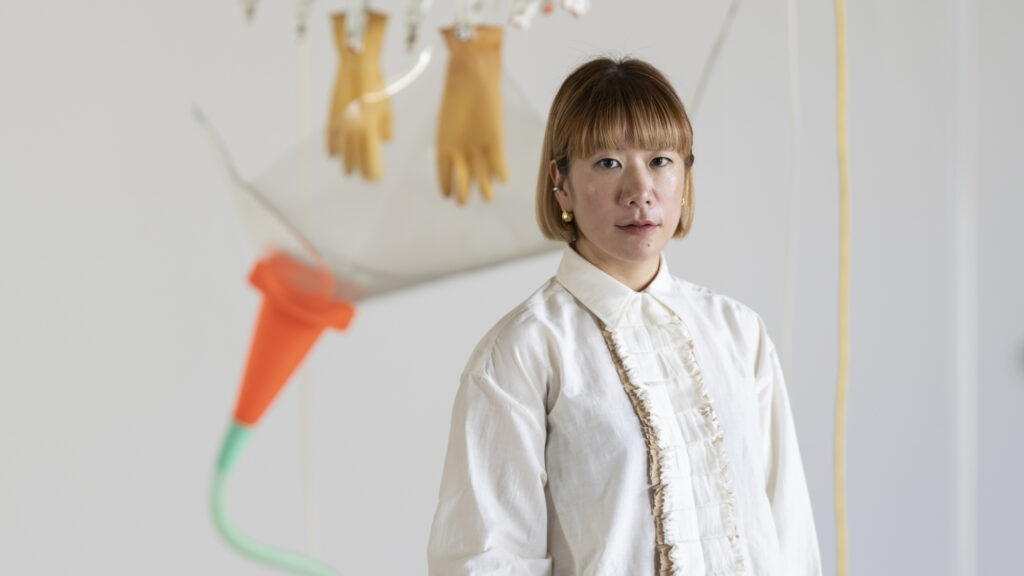

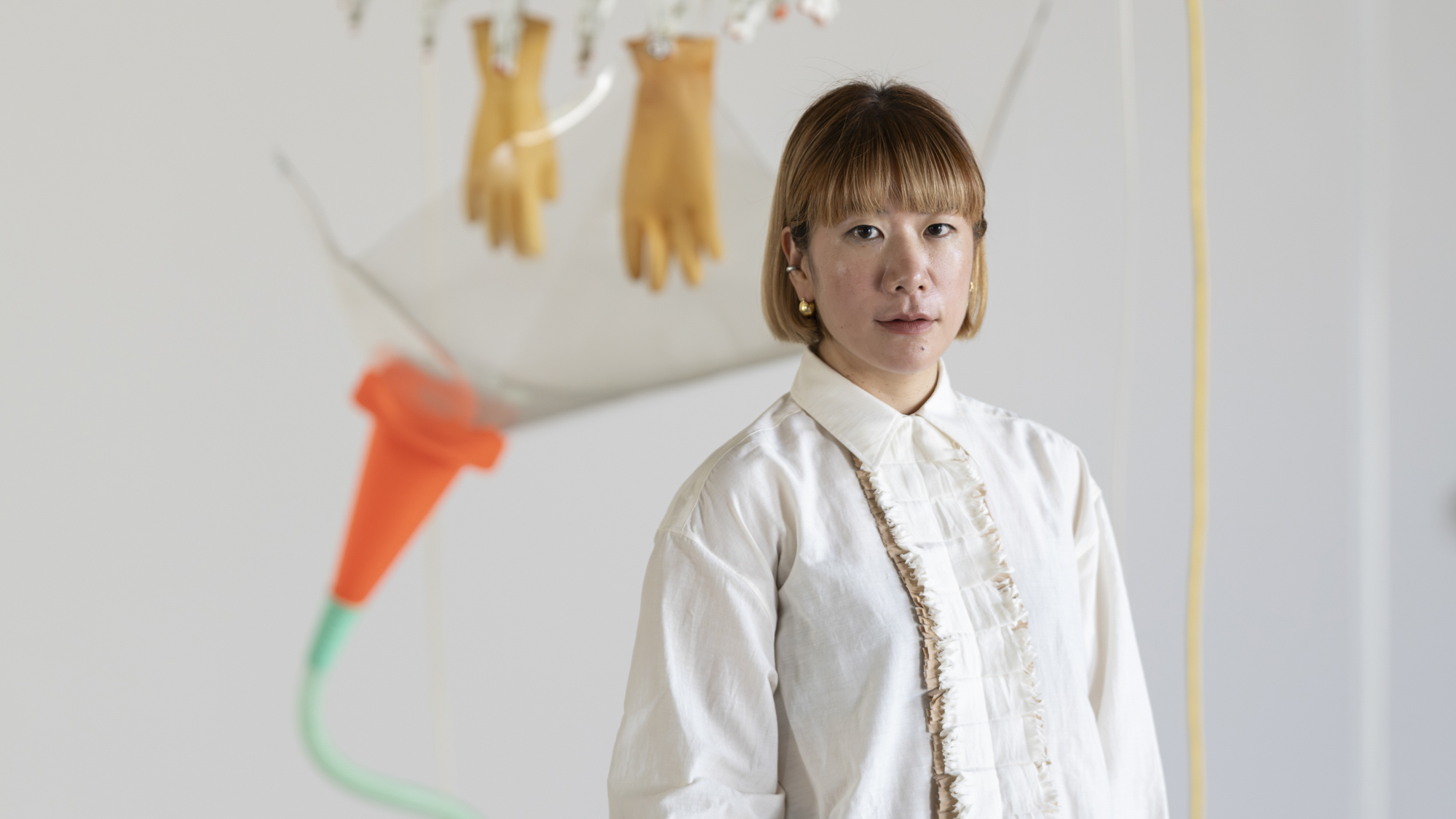
When Yuko Mohri starts working on a new project, she doesn’t have a goal. For her, experimentation equals freedom, which she believes is at the heart of making art.
There is something both familiar and strangely unexpected in Yuko Mohri’s kinetic installations. Made of everyday objects, natural materials like fruits or water, and physical phenomena such as gravity, sound, air, electricity and light, the installations have lives of their own as they move, change and grow over time.
Take Mohri’s Decomposition, a “living dead electronic installation” that transforms the decomposition of rotting fruit into light and sound, revealing that there is life in death.
Since early in her career, Mohri has been influenced by the Fluxus movement of the 1960s and 1970s, which emphasized radical experimentation over the finished product. Her practice also has affinities with Arte Povera, an art movement with roots in Italy, in which inexpensive and everyday materials were used as materials for experimentation.
“Even as an art student, I didn’t think I was going to be an artist. I was more interested in experimental art practices—not just visual art, but also fashion, music, and performance. But instead of standing on a stage, I want to be the audience, with the artwork as the player. I provide the conditions but it’s not up to me what happens after that,” she says.
The importance of error
Based in Tokyo, Mohri describes herself as someone who finds it hard to stay still. She starts each morning with an hour-long walk around the neighbourhood, ignoring the noise of colourful advertisements and people rushing to work, instead paying attention to the small details.
These observations, such as a leak in the ceiling of a Tokyo subway station or tiny living organisms she encounters along the way, often spark ideas for new works.
“It’s fascinating how much the environment can change in the same place. Yesterday, I noticed a spider web on a tree with small drops of water caught in the web. It was so beautiful, and I started thinking about how the water drops stay there. It prompted me to do a test, an interpretation of what I saw,” the artist says.
When Mohri gets to her studio, she doesn’t have a goal, just curiosity pushing her forward. One idea leads to the next one, then the next one. “People these days focus too much on results or how many “likes” they get on Instagram. I think it is important to test and to fail. If I were to create a perfectly beautiful result, I should quit making art.”
From small ideas to revolution
In 2024, Mohri represented Japan at the 60th International Art Exhibition of La Biennale di Venezia and has since had shows in Milan, New York, Seoul and Taipei, to mention a few.
In October, Mohri will have a solo exhibition at the Barbican’s The Curve gallery in London. Her installation will feature objects Mohri has collected on site at the Barbican Centre, a Grade II-listed Brutalist icon that will undergo a major renewal.
Even as her career gathers momentum, Mohri consciously makes time for testing new materials and methods. At a time marked by crises such as climate change and war, Mohri admits that staying positive can be difficult. Yet this makes experimentation all the more important.
“I am an engine and I am always moving. Experimentation provides freedom from society; it is my way to resist. I am very happy if something I make triggers someone to take action. A single idea or action is small on its own, but a combination of a lot of ideas can turn into a revolution.”
Saastamoinen Keynote in Arts: Yuko Mohri
Dance House Helsinki, Cable Factory, November 4, 2026, starting at 5 PM. Free entrance. In collaboration with the Saastamoinen Foundation and the Uniarts Helsinki’s Academy of Fine Arts.
The lecture series, organised by Saastamoinen Foundation and the Academy of Fine Arts of Uniarts Helsinki, promotes international dialogue and opportunities for young artists in the visual arts field in Finland. The annual lecture invites internationally recognised, pioneering figures to Finland.
Read more about the Keynote here.
Text: Laura Iisalo